
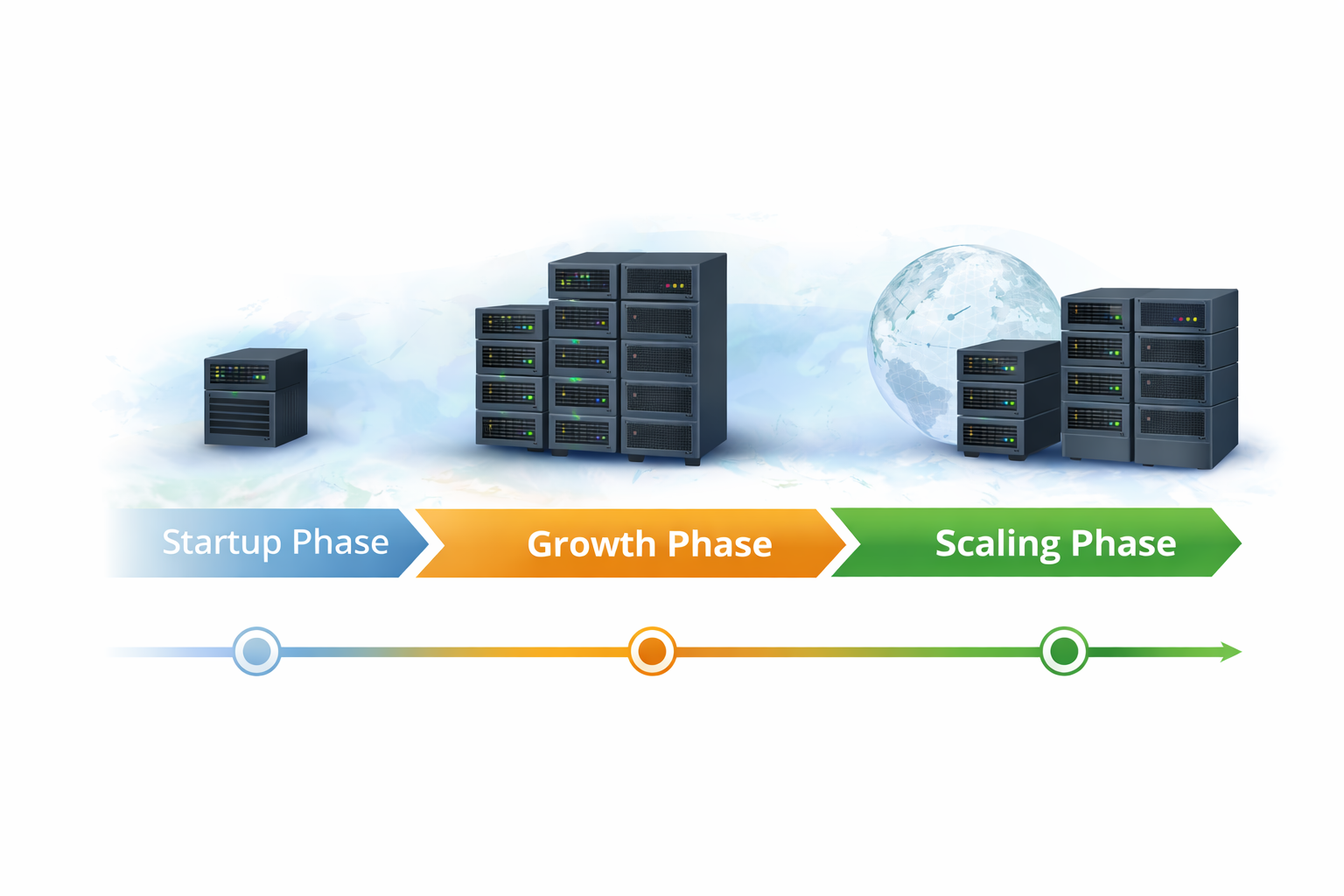
When a website is small, choosing hosting is usually straightforward. A VPS server in USA can provide a useful balance of resources, control, and affordability without requiring the infrastructure associated with a dedicated physical server. However, as traffic increases and applications become more demanding, the same environment that once worked well can gradually become a limiting factor.
Website growth does not always happen in a predictable pattern. A business may experience a steady increase in visitors, seasonal traffic spikes, new applications, larger databases, or more simultaneous users. Each change can place additional pressure on CPU, RAM, storage, and network resources. When these demands become consistent rather than occasional, businesses may need to reconsider whether their current hosting environment is still appropriate.
When VPS Resources Start Becoming a Limitation
One of the first signs of infrastructure strain is consistently high resource usage. Occasional CPU or memory spikes are normal, but sustained consumption can indicate that a website is approaching the practical limits of its current VPS configuration.
Businesses may notice symptoms such as:
Slower page-loading times during busy periods
Longer database response times
Increased application processing time
Performance drops when multiple services run simultaneously
Difficulty handling unexpected traffic increases
More frequent resource allocation adjustments
Increasing VPS resources can resolve some of these issues temporarily. However, continually scaling individual resources may eventually become less efficient than moving to an environment designed for higher and more predictable workloads.
Traffic Growth Is Only Part of the Problem
High visitor numbers alone do not necessarily mean a website needs a dedicated server. The type of traffic and what visitors do on the website can be more important than the total number of sessions.
For example, an informational website with mostly static pages may handle substantial traffic with relatively modest infrastructure. In contrast, an ecommerce platform, SaaS application, membership website, or database-intensive system can require considerably more resources even with fewer visitors.
Dynamic applications often involve several processes at once. A visitor may trigger database queries, account authentication, API requests, inventory checks, payment processes, or personalized content. As simultaneous activity increases, these workloads can compete for the same VPS resources.
Understanding When an Upgrade Makes Sense
Before changing infrastructure, businesses should identify whether the problem is genuinely related to hosting capacity. Poorly optimized code, inefficient database queries, outdated software, and unnecessary plugins can also cause performance problems.
A useful assessment should consider:
CPU utilization: Is processing capacity consistently approaching its limit?
Memory usage: Does the application regularly consume most available RAM?
Storage performance: Are disk operations becoming a bottleneck?
Network requirements: Can the existing environment comfortably support traffic demands?
Traffic patterns: Are spikes becoming more frequent or difficult to manage?
Application growth: Are new services increasing the overall workload?
For businesses currently operating on virtual infrastructure, understanding buy USA VPS online options can also help establish whether a larger VPS configuration can address the problem before a more substantial infrastructure change becomes necessary.
Why Dedicated Infrastructure Can Become the Next Step
When workloads require consistently high resources, moving to a dedicated environment can provide greater resource isolation. Instead of sharing the underlying physical machine with other virtual environments, the business has dedicated hardware resources available for its applications.
This can be particularly valuable when performance consistency becomes a priority. Businesses running high-traffic ecommerce platforms, large databases, resource-intensive applications, or multiple business-critical services may benefit from having greater control over the underlying computing environment.
Dedicated infrastructure can also make resource planning more predictable. Rather than repeatedly adjusting VPS allocations as requirements increase, businesses can evaluate physical hardware according to expected CPU, RAM, storage, and networking requirements.
When Dedicated Infrastructure Becomes the Better Fit
The decision to move away from VPS hosting should not be based on traffic numbers alone. It should be based on whether the existing environment can consistently meet the website's performance and operational requirements. For some businesses, scaling a VPS may remain the most practical option. For others, continued growth can make dedicated infrastructure a more suitable long-term choice.
A dedicated environment can be particularly useful when a website requires predictable access to CPU, memory, storage, and network resources. This can matter for businesses where performance directly affects revenue, customer experience, or application availability. Ecommerce platforms, SaaS applications, media-heavy websites, large content platforms, and systems handling substantial database activity may eventually reach this stage.
Performance Consistency Matters
One major consideration is consistency. A website experiencing occasional traffic increases may not need a complete infrastructure change. However, when high resource consumption becomes the normal operating condition, businesses need to look beyond temporary performance fixes.
Dedicated infrastructure can provide greater control over available hardware resources. This makes it easier for technical teams to plan applications around known CPU, RAM, storage, and networking capabilities.
That predictability can be valuable when businesses are managing several interconnected applications. Instead of constantly monitoring whether a VPS has sufficient resources for another workload, infrastructure planning can be based on the capabilities of the dedicated environment.
Cost Should Be Evaluated Alongside Business Impact
Moving to dedicated infrastructure generally involves a higher hosting cost than maintaining a basic VPS configuration. However, comparing only monthly hosting prices can give businesses an incomplete picture.
Performance problems can have indirect costs. Slow websites may affect user experience, abandoned transactions, customer satisfaction, and employee productivity. Development teams may also spend additional time troubleshooting resource-related problems instead of improving the application.
A better approach is to compare the cost of infrastructure against the operational value it provides. If performance stability and resource availability are becoming business-critical, paying for additional capacity may be more practical than repeatedly addressing limitations.
Migration Requires Planning
Moving from a VPS to dedicated infrastructure should be treated as a technical migration rather than simply changing a hosting package. Businesses need to consider application compatibility, operating systems, databases, storage requirements, DNS configuration, backups, security settings, and expected downtime.
A migration plan should ideally include:
Resource assessment: Review current CPU, RAM, storage, and bandwidth consumption.
Hardware selection: Choose dedicated resources based on current and projected requirements.
Backup preparation: Create and verify current backups before migration.
Environment configuration: Recreate required applications, databases, security controls, and configurations.
Testing: Test applications and critical functions before directing production traffic.
DNS transition: Update DNS records after confirming that the new environment is ready.
Monitoring: Closely monitor performance and errors after the migration.
Planning these steps in advance can reduce unnecessary disruption and make the transition easier to manage.
VPS or Dedicated Server: Which Makes More Sense?
There is no universal answer because infrastructure requirements vary considerably between businesses.
The right choice should be based on workload characteristics, expected growth, application architecture, and business priorities rather than simply selecting the most powerful option.
Planning Beyond the Next Traffic Spike
One common mistake is waiting until a website is already experiencing serious performance problems before reviewing its infrastructure. By that point, technical teams may have limited time to evaluate alternatives or perform a controlled migration.
A better strategy is to monitor resource consumption continuously and establish thresholds that trigger an infrastructure review. Businesses can then identify whether optimization, VPS scaling, or a move to dedicated infrastructure makes the most sense.
This approach also creates room for future growth. Instead of selecting infrastructure solely around today's traffic, businesses can consider expected users, application expansion, database growth, and new digital services.
Conclusion
VPS hosting can be an effective solution for many growing websites, but infrastructure requirements change as traffic, applications, and business operations expand. When resource consumption becomes consistently high and performance stability becomes increasingly important, dedicated infrastructure may offer a more predictable environment.
The key is not to upgrade simply because a website becomes popular. Businesses should monitor actual resource requirements, identify recurring bottlenecks, evaluate the financial impact of performance limitations, and plan infrastructure changes before existing capacity becomes a serious constraint.
For websites experiencing sustained growth, making that assessment early can help create a more stable foundation for future traffic and application demands.
FAQ
When should a website move from VPS to dedicated hosting?
A move may be worth considering when a website consistently reaches its VPS resource limits, experiences recurring performance issues, or requires greater resource isolation and infrastructure control.
Does high website traffic always require a dedicated server?
No. Traffic volume alone does not determine hosting requirements. Application complexity, database activity, concurrent users, and resource consumption are also important factors.
Can a VPS handle a high-traffic website?
Yes. A properly configured VPS can support significant traffic. The important consideration is whether its allocated CPU, RAM, storage, and network resources remain sufficient as workloads grow.
Is dedicated hosting more reliable than VPS hosting?
Dedicated hosting can provide greater control and predictable physical resources, but reliability also depends on infrastructure quality, configuration, monitoring, backups, and operational practices.
Should businesses upgrade before performance problems appear?
Ideally, businesses should monitor resource usage and plan upgrades before existing infrastructure becomes a critical bottleneck. Early planning provides more time for testing and migration.
What should be checked before migrating to a dedicated server?
Businesses should review resource consumption, application compatibility, databases, backups, security configuration, storage requirements, DNS settings, and expected downtime before migration.



Write a comment ...